Pay By Touch Added and Named to Annual AlwaysOn AO100 List
Company Joins Google and Salesforce.com With Recognition as a Leader in Innovation, Market Potential and Investor Value
SAN FRANCISCO, July 28 /PRNewswire/ -- Pay By Touch, the global leader of biometric authentication, personalized rewards and payment solutions, was recently named to the AlwaysOn AO100 List as one of the top privately-held companies.
The AO100 List recognizes the 100 most innovative and successful private firms in the United States based on market potential, customer adoption and investor value.
"The AO100 companies are driving the next wave of innovative technologies that are disrupting the old guard and shaping the new media landscape," said Tony Perkins, founder of AlwaysOn. "As ever, we were inundated with nominations from leading companies, and it's heartening to know that tomorrow's thought leaders and technology visionaries are already out there."
Awarded under the "Services & Enablers" category, Pay By Touch was selected among 1,000 peer nominations in the categories of investors, investment bankers and other industry experts.
John Rogers, Pay By Touch's founder, chairman and CEO, was selected by AlwaysOn to join other CEOs from emerging private companies to present their businesses to a panel of industry insiders and a standing-room-only audience at the AlwaysOn Stanford Summit, July 25-27.
The summit was produced in partnership with the Stanford Technology Ventures Program (STVP).
"It's a tremendous honor for Pay By Touch to join the ranks of Google and other groundbreakers who have previously won this award," said Rogers. "Pay By Touch is not only changing the way the world pays, we are ushering in a new era for biometrics that will change everything for consumers and businesses, from healthcare, to banking, to government."
 Stanford Summit
John Rogers, CEO of Pay By Touch spoke about the company last week on Wednesday, July 28th, during the MIT/Standford Summit CEO Pitch.
He was invited to discuss the company when Pay By Touch was honored with the distinction of being named one of the Top 100 Private Companies in America; The list was based on market potential, customer adoption and investor value.Click this link to hear what he had to say.
 More Shoppers Get in Touch
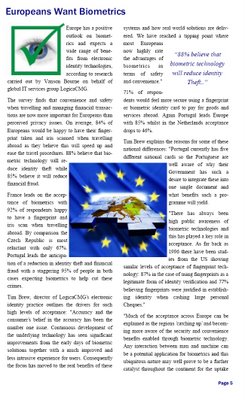
Three more Co-ops are to be kitted out with equipment that will allow shoppers to pay using their index fingerprint after the supermarket chain decided to extend a trial of Pay by Touch technology. (Click Picture on Left to Enlarge)
The biometric payment system is already being trialled in three Co-ops around the Oxfordshire area by the Mid Counties Co-operative.
The pilot was initially slated to last 16 weeks but the society has decided to extend the timeframe for the first three stores and roll out the technology to an additional three stores to see what different demographics think of the technology.
It's been received well by elderly people - they like the idea of going out without having to carry a bag with a purse in it.
A Mid Counties Co-op spokesman told silicon.com the society has extended the trial to get a better insight into customer opinions. "We were very pleased with the trial but we decided we needed more knowledge under our belts," he said.
Registered shoppers have their fingerprint linked with credit card or debit card information and verify payment by pressing their digit against a reader. According to the Co-op, using Pay by Touch is 20 per cent quicker than using chip and PIN.
Recent research by the society found that of the 1,000 shoppers questioned, half had already signed up to the scheme or planned to do so soon. Co-op's spokesman said: "It's been received well by elderly people - they like the idea of going out without having to carry a bag with a purse in it."
The pioneering system of paying for shopping with the touch of a finger has scooped a major industry award for The Midcounties Co-operative. Pay By Touch, has won the ‘Most Effective Use of IT in Retail’ award at the Information Age Effective IT 2006 awards in London. Pay By Touch allows customers to pay by using their finger and a memorable number, so no cash or cards are required.
The Effective IT awards celebrate the best of UK IT, with winners selected for their outstanding application of information technology in the creation of business value.
An independent judging panel, made up of some of the IT industry’s most senior executives, chose the winners from a record number of entries. Awards were presented at Room by the River in London.
Ben Reid, chief executive of The Midcounties Co-operative, said: “Pay By Touch has been a superb innovation for the business and our customers, and we are delighted to have picked up such a prestigious award for its successful introduction.
“It is a quick and secure method of payment for customers, as well as enhancing our reputation as one of the most innovative retailers in the UK. “The initial planning was started by Oxford
The Co-op has not given figures for how long the next phase of the trial will last or how many people have signed up for the program.
The spokesman said: "We've had good feedback and good sign-up. We're happy with the way it's going." The three stores will be situated in the Forest of Dean, Highworth and Swindon.
 Cash and checks are starting to look like ghosts of payments past. Credit and debit cards are the popular ways to pay right now, but some new technologies are showing up to the party, both offline and online.
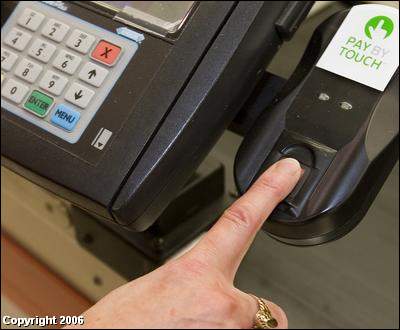
In one of the "more interesting" developments, Pay By Touch has had success in rolling out a biometric system that lets customers pay with a swipe of their finger.
And PayPal recently introduced PayPal Mobile, which lets users send and receive money via cell phone text messaging and is already being used by MTV, the NBA Store and other for-profit and nonprofit companies.
Contactless payments are also slowly rolling out across the nation. These let customers charge items to their accounts by simply waving a card or device near a reader. It's a technology well-suited to purchases that are quick and simple, such as gas, convenience store merchandise or vending machine items. Getting started with contactless payments is rather simple for businesses. "The contactless infrastructure is built on the existing payment network. It's a fairly straightforward process to enhance a terminal to accept a contactless payment as well as a mag stripe payment," says Niki Manby, vice president of market and technology innovation at Visa USA. Still, expect rollout among merchants to be gradual.
Some new online payment technologies are focusing on security issues. For example, Pay By Touch Online utilizes technology to biometrically authenticate you and then allows consumers to use PIN Debit on the Internet for the first time.
See: Pay By Touch announces first ever PIN debit option for online purchases
If you're considering adopting a new payment technology, first take stock of your business needs. Says Manby, "It's not technology for the sake of something new-it's technology to try to solve a problem or improve on a scenario, like getting lines to go faster." These new innovations promise to bring added convenience and security for both merchants and consumers alike.
Digital fingerprint technology holds key to your security and convenience
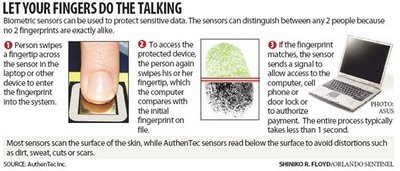 Pay for the groceries, lock the house, start the car, check in at a doctor's office or log on to a laptop. There's so much the swipe of a fingertip can do.
An evolving digital tool, biometric-fingerprint technology holds the promise of replacing or lessening reliance on everyday necessities such as credit cards, key chains and passwords. It even helps registered travelers get through security at Orlando International Airport.
An evangelist of biometrics, Scott Moody is CEO of AuthenTec, a Melbourne company that produces sensors that can read a fingerprint."Looking ahead, I think the use of this technology could become ubiquitous," he said, gazing out the window of his office overlooking the Indian River. "It would just be taken for granted as part of the everyday world."Moody's 8-year-old firm, which employs 89, has grown rapidly, thanks to four infusions of venture capital totaling $63.5 million, with shipments increasing in the past three years from 1.5 million to a projected 7 million to 8 million units in 2006. AuthenTec is among several global suppliers for a market comprising computers, cell phones, home security, autos and building-access controls, presenting a target of about 1 billion sales worth $5 billion to $10 billion this year, Moody said.
Biometric-fingerprint readers are housed in a bit of silicon not much bigger than a fingernail clipping yet powerful enough to capture a fingerprint image that, when magnified, looks like closely packed mountains and valleys in a desert landscape. The silicon slivers are seen as a tool for safeguarding sensitive personal and financial data stored on laptops used by the military, banks, businesses and medical firms. Many business-model laptops now have the biometric devices, said Ray Sawall, Gateway senior manager for professional-notebook management.
Beyond security, convenience could be a major driver for wider adoption in the consumer world, said Forrester Research analyst Jonathan Penn, who sees biometric devices as a tool for making purchases at the supermarket and other stores."I can get through the checkout line faster, and I don't have to carry cash or a debit or credit card," he said.
 A fingerprint-scanning device linked to bank or credit-card accounts, developed by Pay By Touch of San Francisco, is in use at about 2,500 sites across the country, including Coast to Coast, a Tampa convenience store.
Future uses include the ability to pay at the pump for gas and register for a visit at a doctor's office with a finger swipe, said John Morris, Pay By Touch president.
 Individuals seeking to cash payroll or government checks can use a similar biometric tool, called Paycheck Secure, also developed and powered by Pay By Touch technology, at Zions Bank of Utah. "It's convenient for customers, and it keeps us from being defrauded," said David Fuhriman, senior vice president of retail-product management.
Still another version of the technology is a key-chain fob, called plusID, developed by Privaris Inc., a privately held firm in Charlottesville, Va. The 1-inch-long device, which uses an AuthenTec sensor, is a security tool to unlock doors and log on to computers at businesses, Privaris President and CEO Barry Johnson said. It could also be used to lock and unlock home and car doors, he said. But before biometric technology replaces credit cards and makes the key ring obsolete, barriers remain, industry analysts and experts said.
The $5 sensors are still too pricey for mass adoption; there is little awareness of and even less demand for them; and some concerns linger about how secure they really are, experts said. "There's value in it for locking a phone or navigating games," said Chris Bierbaum, Sprint Nextel Innovation Manager."But the price has to come down for a cell-phone carrier to deploy it. And I want to see more testing on security. I need to see confirmation from a gazillion tests."
More optimistic is Joel Fishbein, analyst for Philadelphia-based investment firm Janney Montgomery Scott. "We aren't there yet culturally and aren't willing to give up things we know, but I think we will see early adoption in the next 18 months," he said.
In a business sense, adoption could be hastened by the profit motive, because with Pay By Touch, retailers would pay a lower fee for biometric-based transactions than credit cards, he said. Another proponent is Walter Hamilton, chairman of the International Biometric Industry Association, a nonprofit trade group."I don't have to carry cash, check, credit card or debit card," he said. "I can't leave home without my finger."
POS PointersOpinion: An initiative involving Microsoft and startup IP Commerce could change the landscape in the point-of-sale world.
For 20 years or more, one of the most profitable segments of the channel has been point-of-sale systems sold and configured by solution providers. But as time marches on, there appears to be some significant changes underway in the technology landscape that could significantly alter the traditional POS business model.
Microsoft, in conjunction with a startup company called IP Commerce, is working with a variety of electronic funds transfer services to create a SAAS (software as a service) delivery model for POS.
In this model, retailers would deploy IP Commerce's POS software as a service running on top of Vista. That service would then be connected to a variety of back-end electronic funds transfer agents, which today include BankServ, Chase Paymentech Solutions, CIT Group, Internet Commerce, PayPal and Pay by Touch.
These organizations have bandied together to create a PASS (Payments as a Secure Service) offering that seeks to eliminate the need to create and deploy dedicated POS systems. Instead, any PC running Vista will be able to invoke PASS to securely transfer funds from any retail location by leveraging new sets of security protocols that are layered into the Vista operating system.
The advent of this service poses both a threat and an opportunity for solution providers. The obvious threat is that it has the potential to eliminate the need for specialized POS systems and the solution providers that build them. The opportunity is that it may open the whole POS ecosystem to a broader number of solution providers because they won't have to invest as much capital in setting up a POS system.
Not only does the IP Commerce system manage the transfer of funds, it also provides an accounts payable and receivable management system for the individual retailer as a service. And down the road you can envision how the service might be used to give retailers more visibility into the back-end supply chains of manufacturers.
Given the fact that PASS is dependent on Vista adoption, it will probably be a while before IP Commerce becomes the equivalent of a Salesforce.com in the POS space. But at the same time, the presence of a PASS consortium made up of financial services companies that will be pushing retailers to adopt IP Commerce because it lowers their costs by streamlining their back-end processes makes PASS an impending threat to every solution provider and distributor in the POS space.
And as the saying goes, to be forewarned is to be forearmed. In this case, that will probably result in a pressing need for existing POS providers to start moving upstream to higher-level consulting and management services before what they do today becomes a low-margin service tomorrow.
A Touch of Money By: Anil K. Jain and Sharathchandra Pankanti
Biometric authentication systems for credit cards could put identity thieves out of business
He stole the identities of the world’s rich and famous—Paul Allen, Oprah Winfrey, Steven Spielberg, Warren Buffett, and Larry Ellison, to name a few. Until the New York City police busted 32-year-old Abraham Abdallah, it seemed that a diabolically gifted hacker, not a busboy at a Brooklyn restaurant, had masterminded this multimillion-dollar caper.
However, a tattered copy of a Forbes magazine featuring America’s 400 richest people found in Abdallah’s possession—along with 800 credit cards—exposed the thief’s simple modus operandi.
Here were his targets, listed in order of their net worth, some with Social Security numbers and credit card information scrawled right next to their names. Investigators soon discovered that Abdallah had obtained most of this information from the Internet, as well as from credit bureaus Equifax, Experian, and TransUnion, by sending queries on the forged letterhead of several top investment banks.
With birth dates, addresses, and Social Security and credit card numbers in hand, Abdallah would use a computer at a public library to order merchandise online, withdraw money from brokerage accounts, and apply for credit cards in other people’s names. Things started to unravel when he tried to transfer US $10 million from the Merrill Lynch account of software entrepreneur Thomas Siebel. Someone at Merrill Lynch noticed that the same two Yahoo e-mail addresses, both Abdallah’s, had been used in connection with five other clients. Soon after, on 19 March 2001, two New York City detectives wrestled Abdallah out of his car, ending one of the most sensational identity theft sprees in history.
Catching ID thieves is like spearfishing during a salmon run: skewering one big fish barely registers when the vast majority just keep on going. According to data from the Aberdeen Group, Boston, the cumulative losses suffered by tens of millions of individuals and businesses worldwide registered at an estimated $221 billion in 2003. Aberdeen, which assumed an enormous 300 percent compound annual growth rate, projected that losses would rise to an almost unfathomable $2 trillion in 2005. More recent numbers from Javelin Strategy and Research, based in Pleasanton, Calif., indicate a much lower growth rate, at least in the United States, where total losses rose from about $48 billion in 2003 to $56.6 billion in 2005.
Clearly, it is far too easy to steal personal information these days—especially credit card numbers, which are involved in more than 67 percent of identity thefts, according to a U.S. Federal Trade Commission study. It’s also relatively easy to fake someone’s signature or guess a password; thieves can often just look at the back of an ATM card, where some 30 percent of people actually write down their personal identification number (PIN) and give the thief all that’s needed to raid the account. But what if we all had to present our fingers or eyes to a scanner built into our credit cards to authenticate our identities before completing a transaction? Faking fingerprints or iris scans would prove challenging to even the most technologically sophisticated identity thief.
The sensors, processors, and software needed to make secure credit cards that authenticate users on the basis of their physical, or biometric, attributes are already on the market. But so far, the credit card industry hasn’t seen fit to integrate even basic fingerprint-sensing technology with their enormous IT systems. Concerned about biometric system performance, customer acceptance, and the cost of making changes to their existing infrastructure, the credit card issuers apparently would rather go on eating an expense equal to 0.25 percent of Internet transaction revenues and the 0.08 percent of off-line revenues that now come from stolen credit card numbers.
Indeed, only a few companies worldwide have even experimented with biometric credit cards. The best known is the Bank of Tokyo–Mitsubishi. Since 2004, it has issued Visa cards embedded with chips that identify a customer according to vein patterns in the palm. All of the bank’s ATMs have palm scanners that match the imaged vein patterns to a digitized copy of the customer’s vein patterns—called a biometric template—that is stored in the card. But because merchants lack the requisite palm scanners to go with this technology, customers still sign receipts or enter PINs when making purchases with the card.
All biometric systems recognize patterns, such as the veins in your palms, the texture of your iris, or the minutiae of your fingerprints. As researchers who have investigated and engineered numerous biometric devices, we want to propose the broad outlines of a new authentication system for credit cards, based on biometric sensors that could dramatically curtail identity theft. Our proposed system uses fingerprint sensors, though other biometric technologies, either alone or in combination, could be incorporated. The system could be economical, protect privacy, and guarantee the validity of all kinds of credit card transactions, including ones that take place at a store, over the telephone, or with an Internet-based retailer. By preventing identity thieves from entering the transaction loop, credit card companies could quickly recoup their infrastructure investments and save businesses, consumers, and themselves billions of dollars every year.
If credit card issuers don’t act soon, customers, many of whom are becoming increasingly comfortable with biometric technologies, might just force the issue.
In the United States, millions of people at hundreds of supermarkets have already given the thumbs-up to services offered by BioPay LLC, Herndon, Va., and Pay By Touch, San Francisco, which let shoppers pay for their groceries by pressing a finger on a sensor mounted near the cash register—no card necessary.
Millions more, mostly in Asia, have fingerprint sensors built into their cellphones to act as locks and into their laptops to replace text-based log-ins. All of this activity translates to 29 percent annual growth for a worldwide biometrics market that’s expected to reach $3.4 billion in 2007, according to Research and Consultancy Outsourcing Services, a market research organization based in New Delhi, India. Finger-scanning technology made by companies like Atmel, AuthenTec, Digital Persona, Fujitsu, and Identix will account for almost 60 percent of the total market, the organization estimates. And that market will greatly expand if and when credit card companies get serious about combating ID theft [see photos, “Scanners Galore”].
Current credit card authentication systems validate anyone—including impostors—who can reproduce the exclusive possessions or knowledge of legitimate cardholders. Presenting a physical card at a cash register proves only that you have a credit card in your possession, not that you are who the card says you are. Similarly, passwords or PINs do not authenticate your identity but rather your knowledge. Most passwords or PINs can be guessed with just a little information: an address, license plate number, birth date, or pet’s name. Patient thieves can and do take pieces of information gleaned from the Internet or from mail found in the trash and eventually associate enough bits to bring a victim to financial grief.
Besides trawling the Internet and diving into dumpsters for personal data, thieves exploit people through various cons known collectively as social engineering. A smooth-talking grifter can sometimes get a customer service representative to part with a PIN or reveal other things about an account, such as a mailing address or a phone number. The bank makes it easier for thieves if its authentication protocol is riddled with exceptions. For instance, if you don’t know the PIN, you might be able to provide a mailing address, mother’s maiden name, phone number, or Social Security number to get access to—or at least information about—a particular account. Sometimes those bits of data can be harvested from other sources.
Furthermore, customer service representatives and their managers can usually override authentication procedures when they deem it necessary. A caffeine-addled agent working a double shift may be only too eager to use her override privileges to let you—or your would-be doppelgänger—make a purchase.
To ensure truly secure credit card transactions, we need to minimize this kind of human intervention in the authentication process. Such a major transition will come at a cost that credit card companies have so far declined to pay. They are particularly worried about the cost of transmitting and receiving biometric information between point-of-sale terminals and the credit card payment system. They also fret that some customers, anxious about having their biometric information floating around cyberspace, might not adopt the cards. To address these concerns, we offer an outline for a self-contained smart-card system that we believe could be implemented within the next few years.
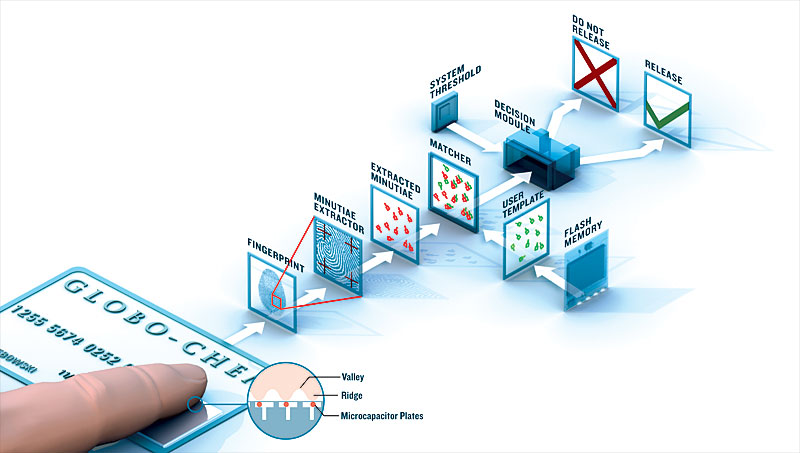
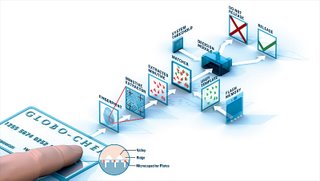
Here’s how it would work. When activating your new card, you would load an image of your fingerprint onto the card. To do this, you would press your finger against a sensor in the card—a silicon chip containing an array of microcapacitor plates. (In large quantities, these fingerprint-sensing chips cost only about $5 each.) The surface of the skin serves as a second layer of plates for each microcapacitor, and the air gap acts as the dielectric medium. A small electrical charge is created between the finger surface and the capacitor plates in the chip. The magnitude of the charge depends on the distance between the skin surface and the plates. Because the ridges in the fingerprint pattern are closer to the silicon chip than the valleys, ridges and valleys result in different capacitance values across the matrix of plates. The capacitance values of different plates are measured and converted into pixel intensities to form a digital image of the fingerprint [see diagram, “Fingerprint Matching”].