Saturday, April 29, 2006

PBT Pins Hopes On a $12 Billion Industry

Mercator Advisory Group has released a new report titled "The Online Opportunity for PIN-Based and "PIN-Less" Debit" which discusses market opportunities to expand usage of PIN-based debit cards in the online environment.

According to the report... "Today's lack of a widely accepted solution for using PINs online has limited the use of EFT debit in this rapidly expanding market."
The report goes on to say...

"Long-term opportunities in the fast-growing e-commerce segment must await the deployment of a proven online PIN technology."

PIN debit at the point-of-sale has grown rapidly, and consumers often favor the use of PIN over signature debit for its perceived security and ease of use. The report tracks debit's growth and key consumer attitudes driving its growth. In the world of e-commerce, debit usage, essentially restricted to signature debit usage, has also grown impressively.

While the e-commerce segment its modest in sales volume today when compared with the total consumer spending market, its rapid growth makes it strategically important as a source of future payment volume.

Mercator's analysis suggest that in 2005 dollars, PIN debit's "fair share" of the e-commerce segment would be $12 billion in sales volume, if a suitable authentication solution were available to ATM cardholders.

The inherently low fraud associated with payments to utilities, educational institutions, financial institutions and other selected categories ensures that transactions authorized by billers and ATM card issuers result in very low fraud rates, even though they are not PIN-secured. Most of these PIN-less payments are for expedited/late pay consumer bills, and miss the huge volume opportunity of pre-authorized recurring payments.

The report estimates the potential market opportunity that could be addressed if PIN debit were allowed as a competitive payment option for recurring bills.


Editors Note: Pay By Touch owns the rights to the world's first and only software based PIN Debit application via their subsidiary, ATM Direct. For a closer look at ATM Direct, (which was featured here on February 13th) click the following link:

If Pay by Touch, is indeed, awarded their patent (which is currently pending) for Internet PIN Debit, then ATM Direct, combined with PBT Online, would become a cash register for Pay by Touch. They would be positioned to cut Internet Retailer's transaction processing costs in half and own the market, which in turn would boost their stock value significantly come IPO time. For further information, I've included some interesting reading below:

Related Links:

ATM Direct Says It Will Test PIN Debit on the Web This Year

Pay By Touch Closes in on 'Biometric Proxy' for PIN in Debit Payments

Pay By Touch Enters the Race to Offer Payments to Web Merchants

Friday, April 28, 2006

Mere touch of the hand pays it all

Mere touch of the hand pays it all

Article from the Birmingham News about how Pay by Touch solves some shoppers Pet Peeves...like waiting forever for customers in front of them to pull out their checkbook (which by the way contains pertinent financial information, for all to see) and taking 5 minutes to write out a check...

Tuesday, April 25, 2006

Nice Play Rick!


Photo gallery
• Monday discusses the incident:
350K
Vin Scully's call of Monday saving the flag


30 years ago today, Cubs center fielder Rick Monday rescues an American flag from protesters (asswipes) on the field at Dodger Stadium on April 25, 1976. (Los Angeles Dodgers)


LOS ANGELES -- It was 1976, a fun year for America. It was the country's bicentennial, the war in Vietnam had ended a year earlier and everyone really wanted to put all the problems from the 1960s, Watergate and Vietnam behind them and just enjoy the country's yearlong 200th birthday party.

On April 25, the Chicago Cubs were visiting Dodger Stadium for a three-game series. Playing center field for the Cubs was Rick Monday, the first player taken in the amateur draft that was created 11 years earlier. Monday was born and raised in Santa Monica, Calif., so playing in front of his friends and family was always special to him. On this day, fate would hand Monday a moment that people still talk about with reverence 30 years later. Monday recounts the moment in his own words.

"In between the top and bottom of the fourth inning, I was just getting loose in the outfield, throwing the ball back and forth. Jose Cardenal was in left field and I was in center. I don't know if I heard the crowd first or saw the guys first, but two people ran on the field. After a number of years of playing, when someone comes on the field, you don't know what's going to happen. Is it because they had too much to drink? Is it because they're trying to win a bet? Is it because they don't like you or do they have a message that they're trying to present?

"When these two guys ran on the field, something wasn't right. And it wasn't right from the standpoint that one of them had something cradled under his arm. It turned out to be an American flag. They came from the left-field corner, went past Cardenal to shallow left-center field.

"That's when I saw the flag. They unfurled it as if it was a picnic blanket. They knelt beside it, not to pay homage but to harm it as one of the guys was pulling out of his pocket somewhere a big can of lighter fluid. He began to douse it.

"What they were doing was wrong then, in 1976. In my mind, it's wrong now, in 2006. It's the way I was raised. My thoughts were reinforced with my six years in the Marine Corp Reserves. It was also reinforced by a lot of friends who lost their lives protecting the rights and freedoms that flag represented.

"So I started to run after them. To this day, I couldn't tell you what was running through my mind except I was mad, I was angry and it was wrong for a lot of reasons.

"Then the wind blew the first match out. There was hardly ever any wind at Dodger Stadium. The second match was lit, just as I got there. I did think that if I could bowl them over, they can't do what they're trying to do.

"I saw them go and put the match down to the flag. It's soaked in lighter fluid at this time. Well, they can't light it if they don't have it. So I just scooped it up.

"My first thought was, 'Is this on fire?' Well, fortunately, it was not. I continue to run. One of the men threw the can of lighter fluid at me. We found out he was not a prospect. He did not have a good arm. Thank goodness.

"Tommy Lasorda was in his last year as third-base coach before he took over for Hall of Fame manager Walter Alston. Tommy ran past me and called these guys every name in the longshoreman's encyclopedia." "A lot of people don't know this, but he beat me to the flag," recalls Lasorda. "I saw Rick start running over from center field to left. I didn't know what it was, but as soon as I saw him start, I took off and I ran out there, and of course, by that time, Rick had picked up the flag and continued running. When I got there, I see these two guys and I told them, 'Why don't one of you guys take a swing at me?' because there were 50-something thousand people in the ballpark and I only wanted them to swing at me, so I could defend myself and do a job on them."

Monday continued, "Doug Rau, a left-handed pitcher for the Dodgers at the time, came out of the dugout and I handed the flag to him. The two guys were led off the field through the Dodger bullpen.

"After the guys left, there was a buzz in the stands, people being aghast with what had taken place. Without being prompted, and I don't know where it started, but people began to sing 'God Bless America.' When I reflect back upon it now, I still get goose bumps."

James Rourke took the picture, and it was nominated for a Pulitzer Prize," said Monday. "This past winter, my wife and I had been looking at a lot of photos that had been in the archives, and one of the photos we came across was a picture of James Rourke and I standing together, holding up the photo that he took. The 30th anniversary means a lot because it was a moment captured in time by James, who is no longer with us, and he has been greatly missed over the years."

Monday, who played for the Dodgers from 1977-83 and has been one of the team's broadcasters since 1993, then recalled the impact the moment had on a country that was wanting so badly to show its patriotism again.

"The letters I've received from that day have run the gamut of emotions. They've been from children who were not born yet and had only heard about it. They've been from Vietnam veterans, including one yesterday. This soldier wrote that there were two things that he had with him in two tours of Vietnam. These two things kept him in check with reality. One was a small picture of his wife. The other was a small American flag that was neatly folded. The picture was folded inside the flag and in the left breast pocket of his uniform.

"He would be in mud for weeks and months at a time. Those two things were what he looked at to connect him with reality, other than his buddies, and some of them were lost in battle. He wrote in the letter, 'Thanks for protecting what those of us who were in Vietnam held onto dearly.'

"That means something, because this wasn't just a flag on the field. This was a flag that people looked at with respect. We have a lot of rights and freedoms -- not to sound corny -- but we all have the option if we don't like something to make it better. Or you also have the option, if you don't like it, [to] pack up and leave. But don't come onto the field and burn an American flag."

Later that year, Monday was given the flag by the Dodgers' general manager at the time, Al Campanis. It hangs proudly in his home in Vero Beach, Fla.

Monday and his wife, Barbaralee, would like anyone who was at that game or a veteran to share their thoughts -- in 500 words or less -- and photos for a book they are putting together about the event that was recently voted as one of the 100 Classic Moments in the History of the Game by National Baseball Hall of Fame. The address is
mvpsportscorp@aol.com.

EuroMoney Article on PBT


EXECUTIVE VICE-PRESIDENT Guy Spanos was considering the prospects for his company, Pay By Touch Solutions. Set up in 2002, its payments technology using finger scans had taken off and was being used in more than 100 (now 2200) stores across the US. Pay By Touch had also made a series of fruitful acquisitions. Now, three years on, Spanos and founder, chairman and CEO John Rogers wanted to refinance their balance sheet and rapidly expand the business at home and abroad.


Spanos was clear about how he wanted to raise capital. Earlier in his career he had worked in the capital markets and knew that this time he wanted financing from hedge funds. Using UBS as a prime broker, Pay By Touch secured $130 million – $75 million of which was raised in senior secured notes from five hedge funds.

An increasing number of companies are taking the same path. As Pay by Touch shows, companies with healthy balance sheets and good growth prospects are discovering that hedge funds can offer an alternative and, perhaps, preferrable source of financing, be it through private equity-type arrangements, private placements, leveraged loans, commercial loans or asset-based lending.

It’s a suitable marriage. Some $80 billion is expected to flow into hedge funds this year, and it needs to be put to work. And for companies, growth is back on agenda, with flexible and tailored financing offered by hedge funds providing a solution. That’s the way Spanos saw it. “Not being a long-established company with an established cashflow, we knew that the traditional banks would not provide a loan,” he says. “At the same time, we didn’t want to use private-equity firms as we didn’t want to dilute our share price or give up control in the company. We wanted flexibility to structure the financing predominantly in the form of debt, and we wanted smart capital, so we went to the hedge fund community knowing we’d find a solution.”

Competitive advantage

Hedge funds have a clear competitive advantage over their traditional private-equity peers. They have bigger pools of capital and their return requirements are lower. “Hedge funds take fees upfront and revalue the assets on a continued basis. Private-equity houses, however, only take their fees out on exit,” explains one lawyer. As a result, hedge funds are able to pay more for companies, leading, private-equity houses lament, to higher purchase prices.

The lack of restriction enjoyed by hedge funds also allows them an edge over traditional private-equity players. At a recent presentation at the University of Pennsylvania’s Wharton School, Och-Ziff’s Dan Och discussed a life insurance investment where his hedge fund was able to offer advantages because of the flexibility of its approach to management control. “Some private-equity firms needed a board seat,” he says. All Och-Ziff required was a one-page legal document declaring that it had the same rights as all the other large capital providers.

For Pay By Touch, the flexibility of the structures was crucial. “It was a highly unusual loan, providing security on the debt from our patent portfolio with a component of equity,” says Spanos. “ A traditional bank would not have provided it. We didn’t have any concerns. Hedge funds are as diligent as private-equity companies and banks. They aren’t quick to pull the trigger, and we liaised with them with the help of UBS throughout the structuring process.”

This new source of financing, however, is putting pressure on other providers. More than half the private-equity professionals surveyed by ACG/Thomson in June complained about the hedge funds’ involvement in their space. With good cause.

Hedge funds were able to offer a more suitable alternative to private equity in the case of Pay By Touch; elsewhere they are acting as pure private-equity houses. In the US in 2004, 23 private-equity deals totalling $30 billion were conducted by hedge funds, and in Europe hedge fund involvement in private equity is growing, with a series of high-profile deals this year.

In the reverse takeover of insurer Britannic Life by Resolution Life, hedge funds were the sole providers of equity. In April, Och-Ziff Capital Management bid in the £1.2 billion ($2.1 billion) auction for Yellow Brick Road, a pan-European directories business; in September, a consortium of six hedge funds, including Och-Ziff, Perry Capital and Citadel, entered talks to take over discount retailer Peacock Group.

Monday, April 24, 2006

Investors Seem to Recognize Value of PBT

Venture capitalists are returning to their old sweethearts, high tech and Internet companies, according a survey of investment activity in the first quarter of 2006. Young technology companies raised $3.36 billion nationwide, up 13 percent from $2.98 billion a year ago. In the Bay Area, technology startups raised $1.26 billion in the first quarter, up from $1.10 billion in the same quarter last year. "I see a continuation of the interest in Internet business models," said Joe Muscat, Americas director of Ernst & Young Venture Advisory Group. Ernst & Young publishes the quarterly report with Dow Jones VentureOne. "I think it started to pick up last year and has accelerated in 2006.

The biggest Bay Area deals featured several companies benefiting from the convergence of telecom, media and Internet technologies. San Mateo's Sling Media, which delivers media content to mobile users via broadband, raised $46.6 million, while Claria, a Redwood City provider of consumer Internet services, raised $40.25 million. The largest deal was Pay By Touch, the San Francisco biometric electronic payment system that raised $60 million.

The Bay Area companies that received the largest VC investments in the quarter were both technology companies:


Pay By Touch
, the San Francisco company that allows consumers to buy things biometrically, with only a fingerscan for identification, and Sling Media, the San Mateo maker of a product that beams television programming to computers and handheld devices. Pay By Touch, in its second round of funding, raised $6o million in January, and Sling Media raised $46.6 million.Pay By Touch has biometric identification systems in 2,000 stores, including Albertsons and Supervalu. Pay by Touch has contracts that put them in 10,000 plus stores by year end. It also plans to offer a version of its product for Internet shopping as well as a health care application.

The company (Pay by Touch) set out to raise just $25 million, but interest was so strong that investors offered four times that. It closed on $60 million in January, after raising $130 million just 90 days earlier.

"It definitely shows that there is an appetite in the market with institutional investors for great inventions, and they will write big checks for great opportunities," said Gus Spanos, Pay By Touch chief financial officer and executive vice president. "I think that our success and the amounts of money we've raised ... really is more specific to investors' recognition that Pay by Touch could truly could be a transformational company."


Original Article Appeared in San Francisco Chronicle and SF Gate.

Related Links

To access the EuroMoney report on the $130 million Pay by Touch raised from hedge funds:
http://www.wingrave.co.uk/news/articles/Euromoney%20Magazine-Hedge%20funds%20article%20Nov%2005.htm

Below is a Reprint of the Wall Street Journal Report on PBT and Hedge Funds:
http://webreprints.djreprints.com/1445480587512.html

Friday, April 21, 2006

Guanxi for Pay by Touch

In China, markets aren't always defined by something that can be mapped—such as a province, a city or a region. Markets can also be defined by a nearly invisible network of relationships. It's not just what you know but who you know—and who they know—that counts. The Chinese have a word for it: guanxi, (jiǎntǐzì) a Mandarin term that loosely translates as "network of influence." Guanxi is rooted in the deep sense of family loyalty that permeates the culture.

The importance of "Guanxi"

Regardless of business experiences in ones home country, in China it is the right "Guanxi" that makes all the difference in ensuring that business will be successful.

By getting the right "Guanxi", the organization minimizes the risks, frustrations, and disappointments when doing business in China.

Often it is acquiring the right "Guanxi" with the relevant authorities that will determine the competitive standing of an organization in the long run in China. And moreover, the inevitable risks, barriers, and set-ups you’ll encounter in China will be minimized when you have the right “Guanxi” network working for you. That is why the correct "Guanxi" is so vital to any successful business strategy in China.

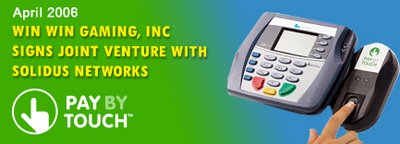
The Lowdown: Pay by Touch forgives $1 million dollar loan, made last September 30th, in return for shares and the right to purchase shares of stock in Win Win Gaming Inc. tantamount to 19% ownership. The agreement also provides Pay by Touch with the ability to market their biometric (and processing) systems in Mainland China. This by itself would mean nothing, but Win Win has government connections..."guanxi."

As part of the Joint Marketing Agreement, Win Win Gaming, Inc. has agreed to the following joint marketing terms and conditions:
Until December 31, 2006, WinWin is obligated to provide PBT with the following support:

A reasonable amount of selling support to assist in driving PBT’s biometric authentication and payment solutions into the Chinese video lottery terminal solution that is being prepared for rollout across China.

* Introductions to senior Chinese government officials with whom WinWin has relationships for the purpose of promoting PBT solutions into other applications beyond video lottery terminals.

* Support from WinWin’s Chinese general counsel for the purpose of making introductions and helping provide tactical and strategic guidance to PBT in connection with its entry into China.

* Physical and logistical support for PBT’s entry into China, including providing access to WinWin’s distribution channels and making available without charge office space in Shanghai.

In addition, under the terms of the cooperation covenants, PBT is required to provide WinWin with reasonable support and assistance in promotional consideration and exposure of WinWin products, services and technologies. PBT is also required to provide WinWin with reasonable support and assistance in identifying sources of equity and debt financing and strategic partners and assistance with obtaining financing from such sources.

Also, under the terms of the cooperation covenants, both parties must use commercially reasonable efforts to identify and exploit opportunities for the benefit of both parties.


Editors Note: (Why This Could be an Important Development for Pay by Touch) The China business market is a very difficult one to get into. "In China, it's not what you know...it's who you know, and if you don't know anybody, you have no chance." - CMO Magazine, January 06

Therefore, with Win Win's contacts, this is one giant step for Pay by Touch in terms of potentially penetrating what promises to be the largest market in the world. Truly a Win-Win Situation. (couldn't resist) By the same token, Win Win is extremely cash poor. Anyway...here's a snippet on Win Win Gamings connections:


Slam Dunk: In the beginning of 2004, Win Win Gaming Inc. entered into an exclusive agreement with the Shanghai China Welfare Lottery to develop new Instant Ticket lottery games and a new TV lottery game show to be marketed throughout the Shanghai region. This agreement is the first of its kind between a U.S.-based lottery/gaming company and the China Welfare Lottery. In addition to the development of several new Instant Ticket lottery games and a full season of prime time TV lottery game shows, Win Win will also provide the marketing for the new lottery products and will consult on overall existing lottery operations in Shanghai.

"This is an unprecedented opportunity for a Western company to be invited to work in partnership with the Chinese government on Welfare lottery operations," said Win Win CEO/President Patrick Rogers. "

The market in China is poised for tremendous growth. This agreement validates the expressed desire of the Chinese government to blend Western-influenced marketing concepts, sales methods and technological innovations with the traditional Chinese approach to lottery operations."

Yu Jianguo, director of Shanghai Welfare Issuing Center, said, "We are very pleased that Win Win can help us on development of new Instant Ticket lottery games tied to a TV lottery game show. We look forward to a new and exciting program to improve our sales for 2004 and we are confident that together we will make it a success." Shanghai China Welfare Lottery was instituted in 1987 with proceeds directed toward the benefit of social programs throughout the area. In 2003, Shanghai China Welfare reports that gross annual sales of the lottery have reached 0.97 billion RMB.

September 21, 2005, Win Win Gaming's wholly owned subsidiary Win Win Consulting (Shanghai) Co. Ltd., entered into a Cooperation Contract with the Shanghai Welfare Lottery Issuing Center ("SWLIC"). Pursuant to this contract, the SWLIC retained Win Win Shanghai to design, market and promote the sale of a second generation of instant scratch off lottery tickets in Shanghai using the Company's "Slam Dunk" brand and trademark (the "Slam Dunk II Tickets"). The Slam Dunk II instant tickets will feature an IVR (Interactive Voice Response) component where players call to receive a "second chance" opportunity to win cash and prizes via an automated phone game. We also plan to roll out Slam Dunk II ticket games in additional cities and provinces throughout China pending final approvals from government lottery officials.

Thursday, April 20, 2006

Discover Needs to Get Creative


Published: April 19, 2006 NEW YORK

Discover Financial is moving its $80 million advertising account to Interpublic Group of Cos.' Martin Agency, Richmond, Va., according to executives familiar with the situation.

"The biggest challenge for the new agency is creating something that broadens the appeal," said David Robertson, the Nilson Report's publisher. "The image has been defined by the product's limitations for a long time."

He said the agency will have to
help Discover broaden the flagship card's appeal AND launch a new debit-card product.

Editors Note: Something
like this?

Pay By Touch

My photo
Scottsdale, Arizona, United States